

Big Happy and Veridooh Partner to Transact on Independently Verified DOOH Impressions
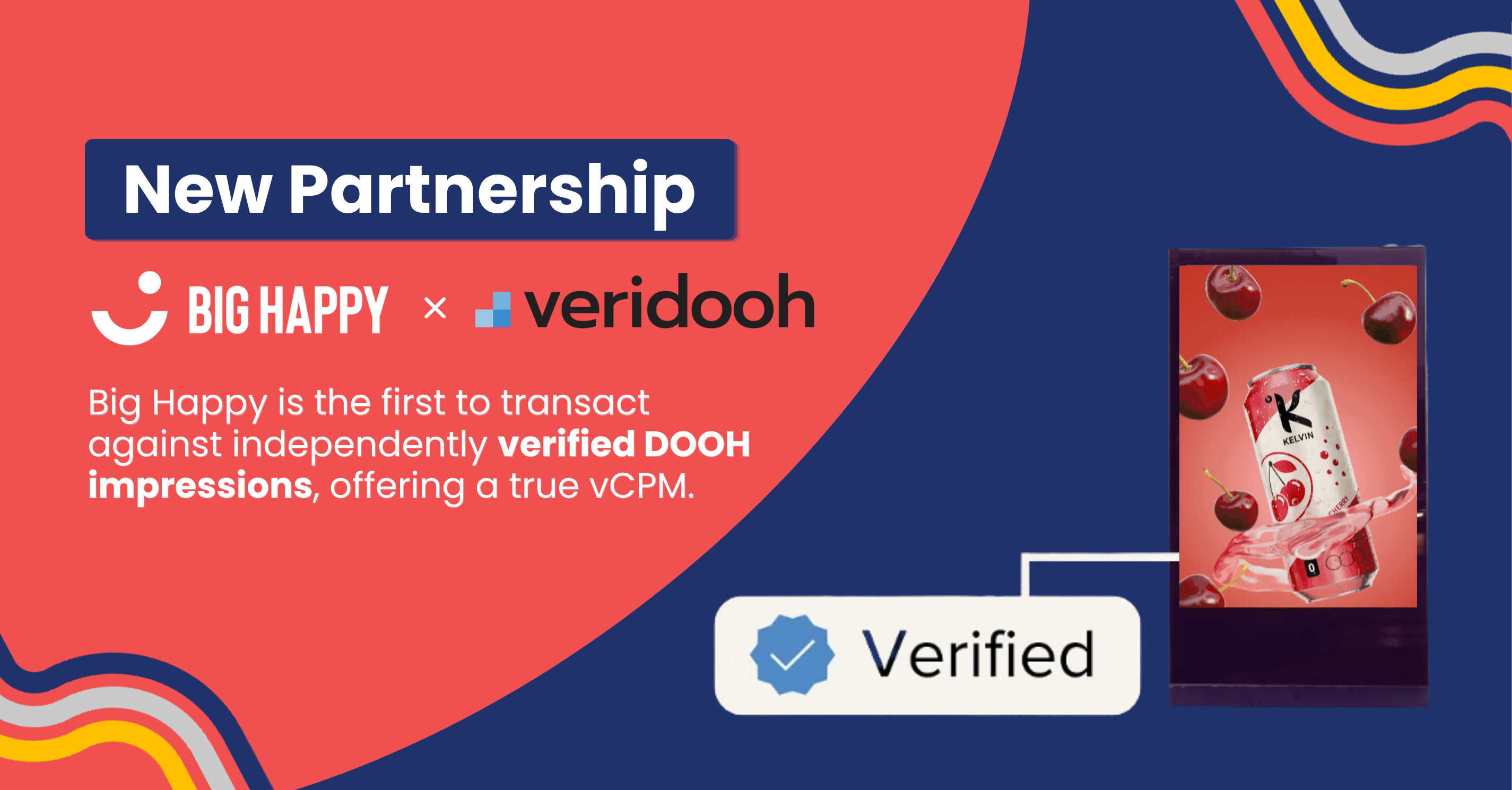
Big Happy is raising the bar on DOOH accountability, officially becoming the first to transact against independently verified DOOH impressions through a new partnership with Veridooh.
Digital out of home (DOOH) has scaled faster than almost any channel in advertising, but accountability? Not so much! Advertisers have largely had to take delivery numbers at face value, with no independently verified impressions. And when you take days, weeks, or even months (you heard that right..months?!) to get your jaw-dropping campaign out to your consumers…don’t you want it to be seen??
Creative is at the center of everything Big Happy does, but even cinematic, 3D DOOH executions are only effective if they actually reach people. Now, we’re verifying that they actually are.
We like to hold ourselves to the highest standard at Big Happy, so “trust us, it ran” isn’t exactly the standard we’re going for.
Today, we’re closing the gap. Big Happy has partnered with Veridooh, the award-winning global leader in 100% independent DOOH verification, to bring independent DOOH impression verification to every campaign. That means advertisers get the same independent verification they already expect from other channels…because DOOH shouldn’t get a free pass!
BUT WAIT. THERE’S MORE. Because we’re not big on doing things halfway, Big Happy is also the first to transact against independently verified DOOH impressions, offering a true Verified CPM (vCPM) model for DOOH campaigns Veridooh's independent verification incorporates more than 400 delivery metrics, including panel play count, exposure time, and creative execution, and checks for plays outside campaign dates or on bonus panels.
"Our creative is built to be immersive, memorable, and available programmatically, and brands should know whether it was delivered as intended. By partnering with Veridooh to launch a vCPM offering, we can give advertisers the option to pay only for valid, independently verified impressions. That prevents wasted ad spend, maximizes ROI, and helps DOOH earn a bigger seat at the table.”
— Gabby, Chief Revenue Officer, Big Happy
“Through our partnership, Big Happy can now offer verified plays and impressions as a new way to transact their programmatic DOOH buys. This is pioneering within the industry as clients will now have the confidence that they will only pay for what is verified. Ultimately, it will increase campaign effectiveness and brand confidence in their programmatic OOH investment.”
— Mo Moubayed, Co-Founder and Co-CEO of Veridooh
What does it mean to independently verify DOOH impressions?
DOOH impression verification is the independent confirmation that an out of home ad actually ran; it checks that the screen it ran on was powered on, undimmed, and ran during the scheduled campaign window (because nobody wants their ad playing to the ghosts that haunt the grocery aisles 4 hours after closing time).
Rather than relying on a media owner's self-reported delivery numbers, an independent third party, Veridooh, checks the underlying screen data itself. It's the same standard advertisers already expect from other digital channels, applied to out of home campaigns. Now out of home can finally be held to the same standard as adjacent channels.
Let’s break this down even more:
How Are Independently Verified DOOH Impressions Confirmed?
Working with Veridooh, Big Happy campaigns can be checked two ways:
- Valid Impressions: Not all impressions are created equal. Screens may be dimmed, operating outside of venue hours, or have limited visibility. Veridooh provides independent verification across media owners and venue types, giving advertisers greater confidence in the impressions they’re buying.
- On-Target Impressions: The media plan, screen list, and targeting parameters are shared upfront and Veridooh flags any delivery outside of that plan.
Together, valid and on-target impressions turn "the ad ran" into something an advertiser can independently verify, the foundation of any credible vCPM DOOH model.
A True vCPM DOOH Model
Big Happy is the first to transact against independently verified impressions in DOOH, offering a true vCPM for DOOH campaigns.
Advertisers can continue buying on a standard CPM or opt into premium vCPM pricing, paying only for impressions independently confirmed as valid by Veridooh.
Summary: The Benefits of Verified DOOH for Brands
For years, advertisers have had to plan DOOH campaigns around estimates: modeled reach, projected impressions, assumptions about what a screen was actually doing while the campaign was live. Independent verification replaces those assumptions with real delivery data, tied to the same screens, dayparts, and locations laid out in the media plan.
- Confidence, not assumptions: Advertisers know their ads ran where they were supposed to, during the hours they scheduled, confirmed by an independent partner, the same standard advertisers already expect in digital and mobile.
- Pay for what gets seen: Independently verified data gives advertisers the option to move to vCPM pricing, so they're paying for impressions independently proven to have played, not just estimated..
- Your creative investment, protected: Big Happy's 3D creative is built to demand attention. Verification makes sure that impact isn't lost to a screen that was dimmed, off, or in the wrong place.
- Sharper optimizations, in-flight and beyond: Independently verified impression data means real mid-campaign optimization, plus better targeting and placement decisions on advertisers' next campaigns.
Independent verification isn't a compliance checkbox. It's what lets DOOH compete on the same terms as every other channel a brand is already buying: reach, context, and impact, backed by accountability.
Big Happy's DOOH campaigns are available in both programmatic and managed-service models, bringing programmatic DOOH accountability and verified reporting to every path to market.
Great creative deserves to be seen. Independent verification provides transparency , so no advertiser has to take delivery data at face value.


Related Posts
Big Happy Expands Unmissable, Story-driven CGI Creative as a Walmart Connect Partner
Big Happy Partners with Veridooh to Bring Independently Verified CPM to Digital Out of Home
Contact Us
New York, NY 10036 contact@bighappy.co


